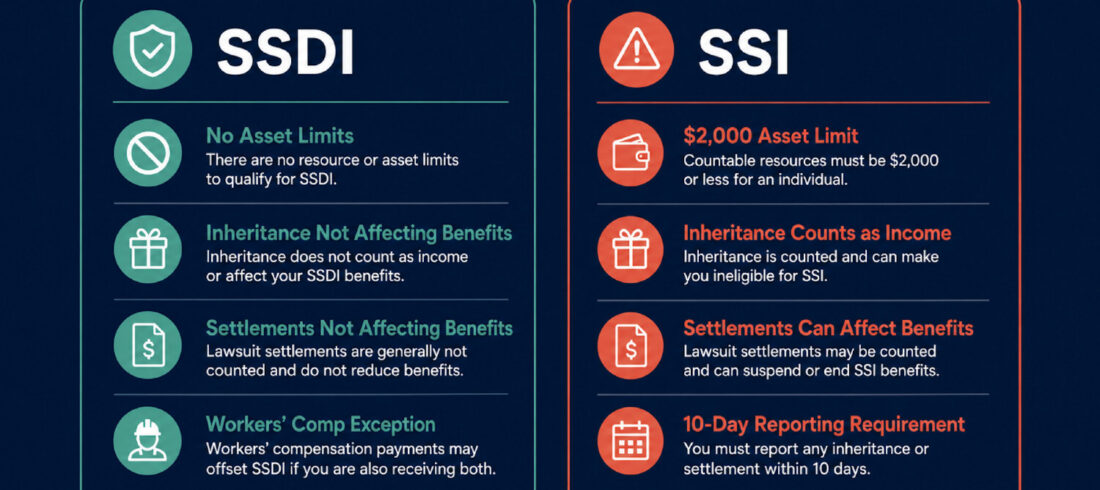
Securing Social Security Disability Insurance (SSDI) and Supplemental Security Income (SSI) benefits in Texas requires navigating a detailed application process. Given the high volume of annual applications, the Social Security Administration (SSA) employs a stringent, five-step evaluation to determine benefit eligibility.
To successfully apply for Texas disability, applicants must present substantial proof that their medical condition prevents them from working, going beyond simply providing a diagnosis.
Below are the five critical steps the SSA uses to assess your claim and how you can meet those specific requirements.
1. Evaluation of Your Current Work Activity

The initial step focuses on your financial situation, examining your current income before addressing any medical aspects. The SSA must confirm you are not engaged in what they define as Substantial Gainful Activity (SGA).
For the year 2026, the monthly income threshold for Substantial Gainful Activity (SGA) has increased. The new limits are:
- $1,690 for non-blind individuals.
- $2,830 for applicants who are blind.
If you earn more than these monthly limits through work, the SSA will typically issue an automatic technical denial of your disability claim.
The SSA also scrutinizes earnings from “sheltered” work or employment with special accommodations. Even part-time work that exceeds the earnings cap can disqualify an applicant. Getting through this first step ensures that benefits are specifically reserved for those whose disabilities truly prevent them from earning a sustainable wage.
2. Proving the Severity of Your Impairment
Once the income requirement is met, the SSA begins to evaluate the severity of your medical condition. To understand how to qualify for disability in Texas, your impairment must be considered “severe,” meaning it significantly interferes with basic functions necessary for work. Examples include physical movements like lifting, walking, or reaching, as well as cognitive functions such as following directions or retaining information.
Texas disability examiners also enforce the “12-month rule.” Your condition must be expected to last, or already have lasted, for at least 12 continuous months, or be terminal. Medical records that suggest your condition will clear up within six months will cause your claim to be denied at this point.
3. Comparing Your Condition to the Listing of Impairments
The SSA uses a “Blue Book” of detailed medical criteria. Claims matching a listing may be approved quickly, especially via Compassionate Allowances for aggressive conditions. If a condition doesn’t exactly meet a listing, the SSA assesses for “Medical Equivalence,” determining if the impairment’s severity equals a listed condition. Success at this stage requires detailed clinical reports.
4. Assessing Your Ability to Perform Past Work

If a severe condition doesn’t meet a “Blue Book” listing, the SSA moves to Step 4, reviewing your “Relevant Past Work” (jobs held in the prior 15 years). They assess your Residual Functional Capacity (RFC), a formal statement of your remaining work abilities. If the examiner determines you can perform any past job duties, your claim will be denied.
5. The Medical-Vocational Grid and Other Work
The final step is frequently the most challenging part of the Texas application process. If you are unable to perform your past work, the SSA poses a simple question: “Are there any other types of work you can do that are available in the national economy?”
To answer this question, they utilize the “Medical-Vocational Grid.” Factors considered in the grid include:
- Your Age: Older workers, generally those aged 50 and above, are typically found to have more difficulty adjusting to new careers.
- Your Education: Your level of formal schooling affects the range of jobs you are deemed qualified to perform.
- Your Transferable Skills: If your past jobs provided skills applicable to lighter, sedentary work, you may be expected to transition to a new field.
If a vocational expert finds that jobs exist that you could perform, even if no openings are currently available in your area, your claim may be denied.
Navigating the Process with Professional Support
Step 5’s complexity often leads to claim denials in Texas. Understanding the federal and local rules causing failures requires expertise. Applicants must prove their case, as missing one medical record or an inadequate explanation of limitations can result in denial.
If you are unsure how to qualify for disability in Texas or have been denied benefits, professional guidance can help. Experienced advocates know how to properly compile and present your Residual Functional Capacity (RFC) and medical evidence to meet SSA standards.
Contact Us for More Information on How to Qualify for Disability in Texas
Ready to apply for Texas disability, but need direction on where to start? National Disability Benefits offers the specialized expertise needed to successfully navigate the 5-step process. We assist you in gathering accurate evidence and submitting your claim correctly from the outset, with no requirement for upfront payment.
Contact National Disability Benefits today to explore your eligibility.