If you recently received a back pay lump sum from SSDI, or you’re expecting one, there’s a good chance nobody warned you that it might affect your taxes. Most people find out at the worst possible time…when they’re sitting across from a tax preparer who tells them they owe money on income they received months ago.
The good news is that SSDI back pay is not taxed the way most people fear. The rules are more nuanced than that, and there are legitimate ways to reduce what you owe, sometimes significantly. Understanding how it works before tax season arrives puts you in a much better position than figuring it out after the fact.
First, Is SSDI Taxable at All?
This surprises a lot of people. Yes, SSDI benefits can be taxable. But not for everyone, and usually not in full.
Whether your benefits are taxable depends on your combined income. The IRS defines combined income as your adjusted gross income, plus any nontaxable interest, plus half of your Social Security benefits received during the year. If that number stays below a certain threshold, your SSDI benefits are not taxable at all.
For single filers, if your combined income is below $25,000, you owe nothing on your benefits. Between $25,000 and $34,000, up to 50 percent of your benefits may be taxable. Above $34,000, up to 85 percent may be taxable.
For married couples filing jointly, the thresholds are $32,000 and $44,000 respectively.
Note that these thresholds apply to the taxable portion, not the tax rate itself. Up to 85 percent being taxable means 85 percent of your benefits get added to your taxable income and taxed at whatever your ordinary income rate is. It does not mean you’re paying 85 percent in taxes. That’s a distinction worth understanding clearly.
Most SSDI recipients who have no other significant income fall below the thresholds entirely and owe nothing on their benefits. The issue with back pay is that a lump sum can push combined income above those thresholds in a single year, even if ongoing monthly benefits alone wouldn’t.
Why Back Pay Creates a Unique Tax Problem
Here’s the core issue. SSDI back pay arrives as a lump sum covering months or sometimes years of benefits that should have been paid out gradually over time. But the IRS counts all of it as income in the year you received it.
So if you received two years of back pay in a single check, that entire amount lands on your tax return for that one year. Even though it was earned across multiple prior years. That can push your combined income into a taxable range it never would have reached under normal circumstances, creating a tax bill that feels completely disproportionate to your actual financial situation.
This is the surprise that catches people off guard. And it’s real. But there’s a provision in the tax code specifically designed to address it.
The Lump Sum Election: The Rule That Can Save You Money
The IRS allows something called the lump sum election method, sometimes referred to as the prior year income averaging method. It’s found in IRS Publication 915, which covers Social Security and equivalent railroad retirement benefits.
Here’s how it works. Instead of counting the entire back pay lump sum as income in the year you received it, you can calculate your tax liability as if the back pay had been paid out in the years it was actually owed. You go back to each prior year, add the portion of back pay attributable to that year into that year’s income, recalculate the taxable amount under that year’s income level, and compare the result to what you’d owe if you counted it all in the current year.
You then pay whichever amount is lower. You don’t file amended returns for prior years. You just use the lower number on your current return. The IRS explicitly allows this.
For people who had little or no income in the years their back pay covers, this method can reduce the taxable portion of the lump sum dramatically. Sometimes to zero. It depends on what your income looked like in those prior years, but for someone who was unable to work and had minimal income during the period their back pay covers, the math often works out very favorably.
This calculation is not simple. IRS Publication 915 walks through the worksheet, but it involves pulling prior year income figures and running the numbers separately for each year covered by the back pay. A tax professional who is familiar with Social Security taxation is worth the cost here. The potential savings can far exceed the preparation fee.
What If Taxes Were Already Withheld
The SSA does not automatically withhold federal income taxes from SSDI payments unless you specifically request it. Most recipients don’t, which means most lump sum payments arrive with no taxes withheld.
If you received a large back pay check and nothing was withheld, you may owe taxes when you file. Whether you owe depends on your combined income and the lump sum election calculation, but it’s worth running the numbers or having someone run them for you before assuming you’re in the clear.
Going forward, if you want taxes withheld from your ongoing monthly SSDI payments, you can request voluntary withholding by filing IRS Form W-4V with the SSA. You can choose to have 7, 10, 12, or 22 percent withheld. This is entirely optional but it prevents a surprise at tax time for people whose combined income puts them in taxable territory.
State Taxes on SSDI
Federal rules are one thing. State taxes are another, and they vary significantly.
Most states do not tax SSDI benefits at all. A smaller number of states do tax them to some extent, and the rules differ by state in terms of thresholds and exemptions. If you live in a state that taxes Social Security income, the same general logic applies as on the federal side — your combined income determines how much, if any, of your benefits are subject to state tax.
Look up your specific state’s treatment of Social Security income. Your state’s department of revenue website is the most reliable source for current rules. This is worth doing because state tax surprises on top of federal ones can compound the problem significantly if you’re not prepared.
SSI Back Pay and Taxes: A Different Situation
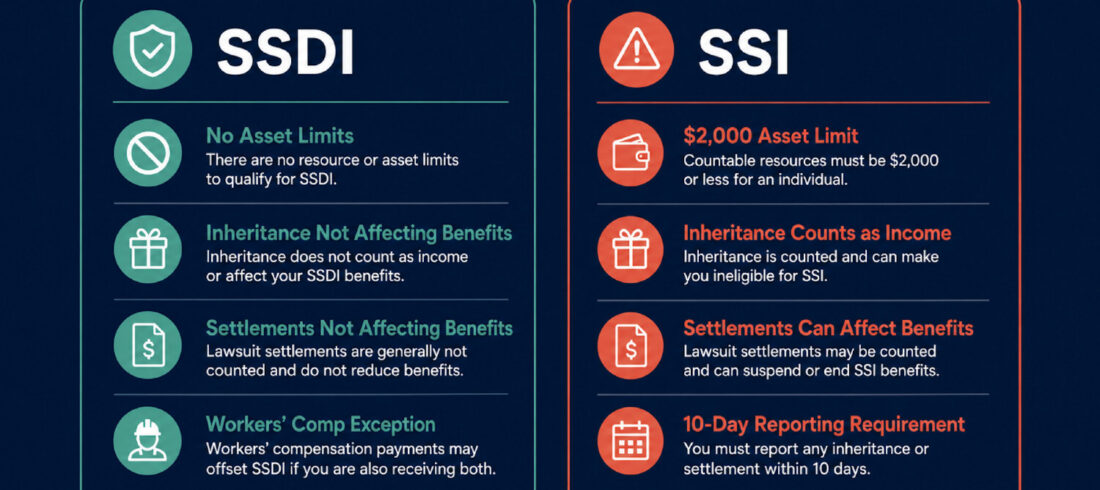
If part of your back pay came from Supplemental Security Income rather than SSDI, the tax treatment is different. SSI is not taxable. At all. Under any circumstances.
SSI is a needs-based program funded through general tax revenue, not through Social Security payroll taxes, and the IRS does not treat it as taxable income. If your back pay included both SSDI and SSI amounts, only the SSDI portion factors into your taxable income calculation.
Your award letter should break down how much of your back pay came from each program if both apply to your situation.
Attorney Fees and Back Pay
If you had legal representation and attorney fees were deducted from your back pay before you received it, there’s a tax wrinkle worth knowing about.
The SSA pays attorney fees directly out of the back pay award. You receive the net amount after the fee is taken out. But for tax purposes, the IRS counts the full gross amount of the back pay as your income, including the portion that went to the attorney.
The attorney fee itself may be deductible, but only if you itemize deductions, and the deductibility of legal fees has changed under recent tax law in ways that make this less straightforward than it used to be. A tax professional can advise on whether this applies to your specific situation. The key point is just to be aware that your taxable income figure may be higher than the check you actually deposited.
Practical Steps to Take Now
If you received back pay this year and haven’t thought about the tax implications yet, a few things are worth doing before filing season arrives.
Track down your SSA-1099. The SSA sends this form in January for the prior tax year. It shows the total amount of Social Security benefits you received, including any back pay lump sum. This is the number that goes into the tax calculation. If you didn’t receive one or can’t find it, you can request a replacement through your my Social Security account at ssa.gov.
Pull your prior year tax returns if you think the lump sum election might apply. You’ll need your adjusted gross income figures from each year covered by your back pay to run the calculation. If those returns are somewhere in a filing cabinet or on a prior year tax software account, dig them out now rather than scrambling in April.
Consider getting professional help for this particular return. SSDI taxation and the lump sum election method are areas where a knowledgeable preparer can save you real money. Not every tax preparer is familiar with Publication 915 and the lump sum election. Ask specifically whether they have experience with Social Security disability taxation before you commit to someone.
If you have ongoing monthly benefits and your combined income puts you in taxable territory, look at setting up voluntary withholding going forward. It smooths out the tax obligation across the year rather than leaving it as a lump sum problem every April.
The Bottom Line
SSDI back pay taxes are a real issue but not a catastrophic one for most people. The thresholds are fairly generous, the lump sum election method exists specifically to address the distortion a large one-time payment creates, and SSI benefits aren’t taxable at all. Most recipients who had little or no other income during the back pay period end up owing far less than they initially feared, sometimes nothing.
The worst outcome is getting caught off guard in April with a bill you weren’t expecting and no time to plan for it. Understanding the rules now, and getting the right help with the calculation if needed, is what prevents that from happening.