For Michigan residents, finding financial stability after a health crisis depends entirely on the duration and origin of the condition. Unlike certain states with mandated, government-funded disability systems, Michigan’s support structure relies on a combination of employer-provided insurance and federal Social Security programs.
To successfully obtain disability benefits in Michigan, individuals must first identify the correct program for their specific timeline. Whether the need is for a brief recovery period or a complete, permanent shift in health status, the current system operates in the following way.
The Gap Between State and Federal Benefits
Michigan does not offer a state-run short-term disability benefit. Residents who are temporarily unable to work must seek financial assistance through other means, as there is no state office to file a temporary claim.
Key facts about disability support in Michigan:
- Short-term needs are typically covered by private insurance or employer-sponsored plans.
- Long-term needs, defined as conditions expected to last at least 12 months, fall under the federal Social Security Administration (SSA).
Because no state safety net exists for temporary medical conditions, the transition period between stopping work and potentially receiving federal benefits requires precise timing to avoid a lapse in income.
Understanding Private and Employer Coverage
Most workers in Michigan access immediate financial assistance through short-term disability insurance (STD). Employers commonly provide these policies as a standard employee benefit. When someone has an STD policy, it typically replaces a portion of their regular salary, usually ranging from 60% to 70%.
These plans function as a financial bridge while recovering from surgical procedures, accidents, or acute illnesses. Most policies include a waiting period, generally seven days, before the payments begin. Be aware that these benefits are time-limited. Most short-term plans will pay benefits for a maximum of three to six months.
If a policy expires and the individual remains unable to return to work, the next step must be to seek long-term disability (LTD) or federal Social Security Disability Insurance (SSDI). Waiting until short-term payments end before planning the next step is a mistake that often causes financial distress.
Michigan Workers’ Comp vs. Social Security
Navigating the relationship between workers’ compensation and disability benefits is critical for securing long-term financial support:
- Michigan Workers’ Compensation is the relevant program for on-the-job injuries, differing from standard disability insurance.
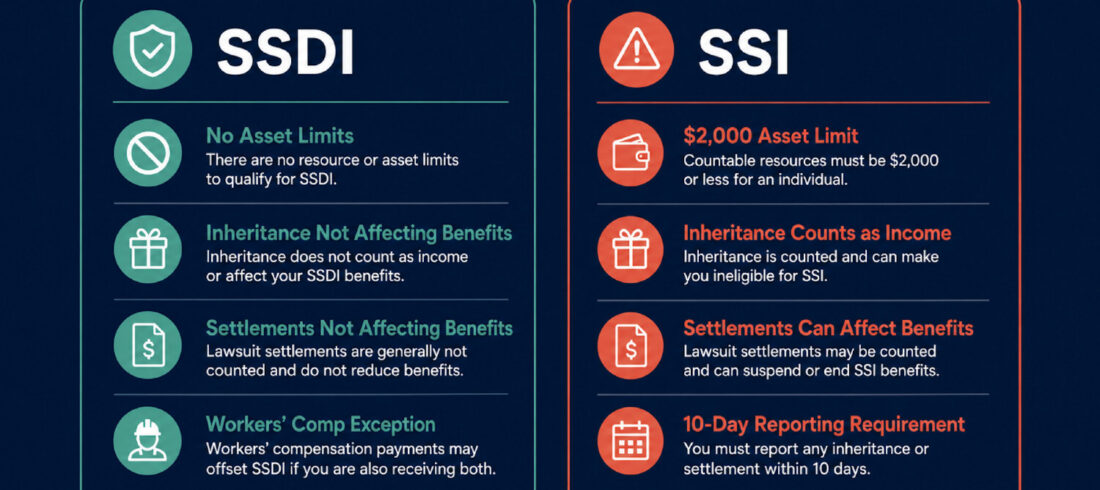
- Receiving both Workers’ Comp and Social Security Disability concurrently typically results in a “Workers’ Comp offset,” reducing the federal payment.
- Applying for Social Security Disability is advisable as soon as it’s clear an injury will prevent work for over a year, due to the slow application process.
- Starting the application early helps ensure long-term support is in place once Workers’ Comp or private insurance benefits end.
Transitioning to Permanent Support
Moving from temporary insurance coverage to federal benefits is often the most challenging aspect of the entire process. The SSA operates on a “total disability” standard. By law, they only provide payments if someone is unable to perform any substantial, gainful work in the national economy due to a verifiable medical impairment.
Many people delay starting their federal application until their short-term benefits have run out. This is a poor strategy. Since the SSA often requires many months, or sometimes years, to approve a claim, the application process should begin while temporary benefits are still being received.
Qualifying for long-term support requires extensive, robust medical documentation. Applicants must successfully prove that their condition represents a long-term barrier to employment, not merely a temporary hurdle. Michigan residents who proactively prepare their medical evidence stand a much better chance of preventing a gap in household income.
Contact Us for More Information on How to Get Disability in Michigan
Trying to navigate the complex layers of insurance and federal regulations while focusing on healing is overwhelming. National Disability Benefits specializes in helping Michigan residents bridge the financial void between temporary setbacks and long-term security.
We are here to assist in determining which programs someone qualifies for and establishing the optimal time to file. Our main objective is to ensure you maximize your monthly income by submitting applications for the correct programs precisely when they are needed.
If there is uncertainty about the necessary next steps or if professional assistance is needed with the federal application process, we stand ready to help.
Contact us today to secure the financial support you deserve.